Buyers compare platforms based on checkboxes, modules, and advertised capabilities. While feature availability matters, understanding how those features function in real workflows is far more important.
This guide breaks down the core entity management software features that organizations rely on every day. It explains what each capability does, why it matters, and how it supports governance, compliance, and operational control as complexity increases.
Why Do Entity Management Software Features Matter?
Entity management software exists to replace fragmented manual processes.
When evaluating features, the goal is not to accumulate functionality. The goal is to ensure that the system reliably supports the work teams must perform to maintain accurate records, meet regulatory obligations, and respond quickly to audits and transactions.
Strong feature design reduces operational friction. Weak or unnecessary features add overhead and slow adoption.
Understanding core capabilities helps organizations avoid overbuying and select platforms that fit their needs.
Centralized Entity Database
The centralized entity database is the foundation of any entity management platform.
This database stores structured information about each legal entity, including:
Legal names and aliases
Jurisdictions of formation and registration
Formation dates and entity type
Officers and directors
Ownership structure
Current status and standing
The value of a centralized database lies in consistency.
When entity data lives in one system, teams reduce discrepancies across spreadsheets, documents, and internal systems. Updates occur in one place and propagate throughout the platform.
For organizations managing multiple entities, a centralized database becomes the single reference point for legal, compliance, finance, and leadership teams.
Compliance Tracking and Deadline Visibility
Compliance tracking is also an important entity management software feature.
Organizations must manage a range of obligations across jurisdictions, including:
Annual and periodic filings
Registered agent requirements
Good standing maintenance
Disclosure and reporting obligations
Some entity management software tracks these requirements and surfaces upcoming deadlines and completion status, providing clear visibility into due dates, confirmation for completed files, and a historical record of compliance activity.
This feature reduces reliance on manual calendars and individual reminders.
Compliance tracking is especially important for organizations operating across states or countries. As obligations multiply, manual tracking becomes harder to sustain.
Document Management Tied to Entities
Entity-related documents – from formation documents to ownership and transfer records – carry legal and regulatory significance.
Entity management software stores these documents in a centralized repository and links them directly to the relevant entity record.
This structure ensures that documents are accessible in context. Teams can locate the correct record quickly and confirm that it reflects the current state of the entity. Document management within entity systems supports audits, transactions, and internal reviews by reducing retrieval time and improving confidence in accuracy.
Organizational Charts and Ownership Visibility
As organizations grow, ownership structures become more complex.
Entity management software generates organizational charts that visualize:
Parent and subsidiary relationships
Ownership percentages
Jurisdictional structure
These charts are created from underlying entity data rather than maintained manually.
Ownership visibility supports multiple functions, including compliance, reporting, and transaction readiness. It reduces reliance on static diagrams that quickly become outdated. For organizations with multiple subsidiaries, ownership visibility is a key requirement.
Workflow and Task Coordination
Entity management involves recurring tasks. such as filings, updates, reviews, and approvals.
Without structure, work relies on memory and email, introducing significant risk.
Entity management software often supports workflow and task coordination by:
Assigning responsibility for specific actions
Tracking progress and completion
Logging activity for audit purposes
These workflows do not need to be complex. Their value comes from accountability and visibility. When tasks are clearly assigned and status is visible, teams reduce duplicate work and missed steps.
Reporting and Audit Readiness
Entity data is frequently requested under time pressure. For example, audits, financings, regulatory inquiries, and internal reviews all require fast access to accurate information.
Some entity management software supports reporting by enabling teams to generate:
Entity status summaries
Compliance completion reports
Ownership and structure exports
Historical activity logs
Because data is centralized and structured, reports can be generated without manual reconciliation.
This capability improves audit readiness and reduces stress during high-stakes events.
Access Controls and Security
Entity data is sensitive.
High-quality entity management software includes access controls that allow organizations to define who can view or edit specific records.
Core security features typically include:
Role-based access
Permissions by entity or document type
Activity logging
These controls ensure that access is intentional and auditable, without making the system difficult to use. Strong access control supports collaboration across teams while protecting sensitive information.
Integrations That Reduce Duplicate Work
Entity management software does not operate in isolation.
Organizations often maintain data across legal, finance, and compliance systems. Integrations reduce duplicate entry and help keep records aligned.
Common integrations include:
Document and e-signature tools
Legal service providers
Internal reporting systems
For most organizations, integration value lies in efficiency, not complexity. Lightweight integrations that reduce manual work deliver the most benefit.
Change Tracking and Historical Records
Entities change over time. Officers are appointed or removed. Ownership shifts. Jurisdictions are added. Entity management software tracks these changes and maintains historical records.
Change tracking supports defensibility. Teams can explain when updates occurred and how records evolved. This capability is particularly important during audits and transactions, where historical accuracy matters.
Scalability Across Entity Volume
As entity counts grow, systems must scale without adding administrative burden.
Entity management software is designed to manage dozens or hundreds of entities using standardized processes.
Scalability depends on predictable performance as volume increases, clear organization of records, and consistent workflows. Platforms that struggle at higher volume introduce friction and increase risk.
Feature Depth Versus Feature Bloat
Not all features add value.
Some platforms include extensive customization options, modules, or dashboards that are rarely used. These features can increase complexity and slow adoption.
Organizations benefit from focusing on core capabilities that support daily work. Feature depth should align with actual needs rather than theoretical use cases.
Understanding which features matter most helps buyers avoid overbuying.
Evaluating Features During Demos
Product demos often highlight advanced capabilities.
Buyers should guide demos toward real scenarios, such as:
Updating ownership or officers
Tracking an upcoming filing
Retrieving documents for an audit
Generating compliance reports
These workflows reveal how features function in practice.
How Entity Management Software Features Support Different Use Cases
Feature priorities vary by organization.
For example, enterprises managing subsidiaries may prioritize ownership visibility. Compliance teams often focus on deadline tracking and reporting. Legal teams rely on document management and governance records.
Evaluating features in the context of specific use cases leads to better outcomes.
Our Final Thoughts…
Entity management software features exist to support control.
The most effective platforms deliver accurate data, clear compliance visibility, and accountability without introducing unnecessary complexity. Features should reduce risk and effort, not add to it.
Understanding the core entity management software features helps organizations evaluate platforms with confidence. When available features align with real workflows, entity management becomes a reliable operational foundation rather than a maintenance burden.
For buyers, clarity around feature priorities is one of the strongest indicators of long-term success.
Entity management rarely starts as a strategic priority.
For many organizations, it begins as a spreadsheet or a shared drive owned by one person who “knows where everything is.” That approach often works early on, when entity counts are low and regulatory exposure is limited.
However, as organizations grow, the manual entity management weakens.
New subsidiaries are added. Operations expand across states or countries. Regulatory obligations multiply. Filing calendars become harder to track. Documentation spreads across systems and inboxes.
At that point, entity management stops being a background task and becomes a source of real operational risk.
Entity management software exists to address that shift. Ideally, it provides structure, visibility, and accountability for organizations that can no longer rely on manual tracking.
In this entity management software guide, we’ll first address three common entity management software basics for individuals hoping to learn. Then, we’ll tackle some specifics.
Let’s get started!
Defining Entity Management Basics
What Is Entity Management Software?
Entity management software is a system used to manage information related to an organization’s legal entities. These entities may include corporations, LLCs, partnerships, subsidiaries, and international affiliates.
At a functional level, entity management software serves as a centralized system of record. It stores and organizes entity data such as:
Legal names and jurisdictions
Formation dates and registration details
Ownership structure
Officers and directors
Compliance status and filing history
Governance and legal documents
Modern platforms extend beyond static recordkeeping. They support compliance tracking, reporting, task coordination, and controlled access across teams.
The objective is to ensure that entity information remains accurate, current, and accessible whenever it’s needed.
Entity management software sits at the intersection of legal, compliance, finance, and operations. It supports day-to-day governance while also enabling faster responses during audits, transactions, and regulatory reviews.
What is the Core Purpose of Entity Management Software?
The core purpose of entity management software is to support governance, accountability, and organizational readiness.
As organizations grow, leadership requires confidence that legal entities are structured correctly, filings are current, and records are defensible. Entity management software provides the infrastructure that makes that confidence possible. It creates a reliable foundation for oversight, decision-making, and execution.
From a governance perspective, the system establishes clear ownership of entity data and obligations. Updates are traceable, responsibilities are defined, and changes can be reviewed when questions arise. This structure reduces ambiguity and supports internal controls across legal, compliance, and operations teams.
Entity management software also plays a critical role in audit and transaction readiness. Accurate, current records allow organizations to respond quickly to due diligence requests, regulatory inquiries, and financing events. Instead of assembling information under pressure, teams can rely on existing documentation and reporting.
At the executive level, entity management software improves visibility into the organization’s legal structure and exposure. Leaders gain a clearer view of risk, compliance posture, and operational dependencies, which supports planning and reduces uncertainty during periods of change.
Together, these outcomes shift entity management from a reactive administrative function to a disciplined operational capability that supports long-term scale.
Why Do Organizations Need Entity Management Solutions?
Entity management solutions are needed when gaps in control start to create measurable exposure.
Without a structured system, organizations face increasing risk as entity counts grow and regulatory requirements compound. Issues that seem manageable in isolation often stack up quickly.
Common consequences include:
Regulatory penalties or loss of good standing due to missed or misinterpreted filing obligations
Delayed transactions caused by incomplete or inconsistent entity records
Extended audit timelines driven by fragmented documentation
Operational slowdowns when entity data cannot be verified quickly
Heightened risk when critical knowledge resides with a small number of individuals
These outcomes are not isolated events. They compound over time and directly affect governance, compliance, and execution.
Entity management solutions address these risks by enforcing consistency and accountability. They create standardized processes for maintaining entity data, tracking obligations, and documenting changes. Responsibilities are visible, updates are logged, and records remain defensible.
As regulatory expectations increase, particularly around transparency, ownership disclosure, and cross-jurisdictional compliance, informal tracking becomes harder to justify. Organizations operating in multiple states or countries must manage overlapping deadlines, varying rules, and evolving reporting requirements.
Entity management solutions provide the structure needed to manage that complexity reliably. They reduce dependency on manual oversight and enable organizations to maintain control as scale and scrutiny increase.
What Can You Expect From This Guide?
Why organizations adopt entity management software, and how it supports governance, compliance, and scale
Written for operators, legal teams, compliance leaders, and executives responsible for maintaining control as organizational complexity increases
This guide is organized to support different stages of evaluation.
It begins by establishing the role entity management plays as organizations grow in size and complexity. From there, it outlines the core capabilities of entity management software and how those capabilities apply across different use cases.
Subsequent sections explore the broader market landscape, pricing models, and considerations for selecting the right solution. The guide concludes with implementation guidance and a discussion of business impact.
Each section links to a deeper, focused resource for readers who want more detail.
Together, these sections form a complete reference for understanding, evaluating, and adopting entity management software.
Core Features of Entity Management Software
Entity management software is built around a consistent set of capabilities(Spoke 3: Legal Entity Management vs. Manual Tracking: Why Software Wins) that support governance, compliance, and operational coordination. While vendors vary in depth and presentation, the underlying features remain largely the same.
These features exist to solve practical problems. They help teams maintain accurate records, track obligations, and respond quickly when information is required.
At a high level, core feature (Spoke 1: Entity Management Software Features: Core Capabilities Explained) areas include:
1. Centralized Entity Database
At the core of every entity management platform is a centralized database that stores entity information in a structured format. This typically includes legal names, jurisdictions, formation dates, ownership details, officers, directors, and current status.
The value of a centralized database comes from consistency. When entity data lives in one system, teams reduce discrepancies and avoid maintaining parallel records across spreadsheets and documents.
2. Compliance Tracking and Deadlines
Compliance tracking provides visibility into filing obligations and entity status across jurisdictions. Most platforms support deadline calendars, filing status indicators, and confirmation tracking.
This capability helps organizations maintain good standing and reduces the risk of missed or late filings. As regulatory requirements grow more complex, having clear visibility into obligations becomes increasingly important.
3. Document Management
Entity management software typically includes document storage tied directly to each entity record. This allows teams to associate formation documents, governance materials, ownership records, and filings with the entities they support.
At the core feature level, document management ensures that entity records and supporting documentation remain connected and accessible. Documents can be located quickly, referenced in context, and shared across teams without relying on separate storage systems.
More advanced document workflows, including versioning, permissions, and audit support, are addressed later in this guide.
4. Organizational Charts and Ownership Visibility
Automated organizational charts visualize relationships between parent entities, subsidiaries, and affiliates. These charts are generated from entity data rather than maintained manually.
Ownership visibility supports reporting, compliance, and planning activities, particularly for organizations operating across multiple jurisdictions.
5. Workflow and Task Coordination
Workflow features assign responsibility for tasks such as filings, updates, and reviews. Task tracking improves accountability and helps teams manage recurring obligations.
These workflows support consistency without requiring heavy customization.
5. Reporting and Audit Readiness
Reporting capabilities allow teams to generate summaries of entity status, compliance completion, and ownership structure. Reports support audits, financing events, and internal oversight.
Because data is centralized, reporting becomes faster and more reliable.
Entity Management Software for Different Use Cases
Entity management software supports a range of use cases depending on organizational structure, industry, and regulatory exposure. Understanding these use cases helps teams prioritize features and evaluate fit.
Managing Subsidiaries and Corporate Structures
Organizations with multiple subsidiaries face challenges related to ownership tracking, jurisdictional compliance, and reporting. Entity management software helps maintain visibility into how entities relate to one another and where obligations exist.
For enterprises with layered structures (Spoke 4: Entity Management for Subsidiaries: Streamlining Corporate Structures), centralized entity data and automated organizational charts reduce confusion and support governance.
Entity Management for Compliance and Risk Teams
Compliance teams rely on accurate records and timely filings to maintain good standing. Entity management software supports this work by tracking deadlines, documenting completion, and providing visibility into status across the organization.
These capabilities support audit preparation and reduce the likelihood of regulatory issues. Compliance officers benefit(Spoke 9: Entity Management for Compliance Officers: Meeting Regulatory Requirements) from systems that surface risk early and provide defensible records.
Entity Management for Legal Teams and General Counsel
Legal teams use entity management software to support governance, board activity, and transaction readiness. Accurate entity records are critical during due diligence, restructuring, and mergers.
Legal-focused workflows( Spoke 6: Entity Management Software for Legal Teams and General Counsel) often include document management, resolution tracking, and coordination with outside counsel.
High-Volume and Portfolio-Based Entity Management
Organizations managing large numbers of entities prioritize consistency and efficiency. Manual updates and bespoke processes do not scale well in high-volume environments.
Entity management software provides standardized workflows and centralized visibility that allow teams to manage large portfolios without proportional increases in staff effort.
Entity Document Management as a Core Capability
Document management becomes a critical capability (Spoke 10: Entity Document Management: Centralized Storage and Retrieval Systems) as organizations face audits, transactions, and regulatory reviews that require fast access to accurate records.
Entity-related documents carry legal and compliance significance. These records are often requested with limited notice and must reflect the current state of the entity. When documents are scattered across shared drives or personal folders, retrieval slows and confidence in accuracy declines.
Entity management software provides a structured approach by tying documents directly to entity records and maintaining them within a governed system. This supports clearer ownership, controlled access, and better traceability as records evolve over time.
Common document categories managed within entity systems include:
Formation and amendment records
Operating agreements and bylaws
Board resolutions and minutes
Ownership documentation
Certificates of good standing
Beyond storage, document management supports defensibility. Version history, access controls, and clear association with entity records reduce ambiguity during audits and due diligence. Teams can demonstrate when documents were updated, who had access, and how records align with current filings.
As entity volume increases, document discipline becomes harder to maintain manually. Centralized document management within entity systems helps organizations maintain consistency, reduce retrieval time, and support governance requirements without introducing additional tools.
The Entity Management Software Market Landscape
The entity management software market includes a wide range of solutions designed for different organizational needs.
Platforms generally fall into several broad categories. Some tools focus on delivering core functionality with minimal configuration. Others offer expanded feature sets designed to support more complex governance, reporting, and compliance requirements. Enterprise platforms are built for organizations with layered structures, high regulatory exposure, or extensive customization needs.
Differences between platforms often relate to:
Scope of features and configurability
Implementation effort and time to value
Pricing structure and scalability
User experience and adoption across teams
Organizations vary in how much complexity they need to manage. Understanding where a solution sits within this landscape helps teams assess whether a platform aligns with their entity volume, regulatory exposure, and internal workflows.
Categorization matters because it shapes expectations. A solution designed for high-volume simplicity will behave differently than one built for deep customization. Evaluating platforms( Spoke 2: Best Entity Management Software: 2026 Comparison Guide) within the right category reduces the risk of selecting a system that introduces unnecessary overhead or limits future growth.
How Features, Use Cases, and Market Fit Intersect
Choosing entity management software requires connecting organizational needs to the right category of solution((Spoke 5: Entity Compliance Tracking: Automated Solutions for Staying Current).
A practical evaluation starts with use cases.
Teams should identify how entity data is used across legal, compliance, finance, and operations, and which workflows depend on accurate, current records. This clarifies which capabilities are essential and which are optional.
Next, feature requirements should be assessed in the context of those use cases. Core functionality may be sufficient for some organizations, while others require more advanced governance, reporting, or compliance support. The goal is alignment between features and real workflows rather than breadth alone.
Finally, market fit determines whether a platform can support both current needs and expected growth. This includes assessing how the system scales with entity volume, adapts to regulatory change, and fits within existing operational processes.
Together, these factors create a framework for evaluation that moves beyond feature lists. This framework supports disciplined decision-making and prepares organizations for vendor comparison and selection.
With an understanding of the solution landscape and core capabilities, the next step is evaluating cost, implementation considerations, and selection criteria in more detail.
Pricing Models and Cost Considerations
Entity management software pricing varies widely(Spoke 7: Entity Management Software Pricing: Plans, Costs, and ROI Analysis)based on platform design, feature scope, and target customer.
Most vendors price their software using one or more of the following models:
Per-entity pricing, where cost scales with the number of legal entities
Tiered plans based on entity count or feature access
User-based pricing layered on top of entity limits
Enterprise licensing for large or complex organizations
While subscription pricing is the most visible cost, it is not the only one that matters. Organizations should also account for implementation effort, internal time spent maintaining the system, and the cost of underutilized features.
As entity counts grow, pricing models that scale predictably tend to be easier to manage. Sudden cost increases tied to usage thresholds or add-on modules can complicate budgeting.
How to Choose the Right Entity Management Software
Selecting an entity management platform requires more than comparing feature lists. The goal is to align the system with how the organization operates today and how it expects to grow.
Key evaluation factors include:
1. Entity Volume and Growth
Organizations should assess current entity count alongside projected growth. A system that works for ten entities may struggle at one hundred.
2. Jurisdictional Complexity
Operating across multiple states or countries introduces additional compliance requirements. Software should support the jurisdictions relevant to the organization’s footprint.
3. Compliance Risk Profile
Some organizations face higher regulatory exposure due to industry, ownership structure, or transaction activity. Compliance tracking capabilities should reflect that risk.
4. Internal Team Structure
How work is divided across legal, compliance, finance, and operations teams affects workflow design and access controls.
5. Implementation Effort
Time to value matters. Systems that require extensive configuration or external consultants may delay benefits.
6. Ongoing Maintenance
Entity management is not a one-time setup. The system should be easy to maintain as entities change over time.
Organizations benefit from prioritizing clarity and fit over breadth. A structured evaluation process(Spoke 8: How to Choose Entity Management Software: Complete Buyer’s Guide)helps avoid overbuying and reduces long-term friction.
Getting Started With EM Software
Implementing entity management software typically follows a consistent sequence, regardless of vendor.
Common steps include:
Inventorying existing entities and records
Cleaning and validating entity data
Uploading or migrating documents
Configuring compliance calendars
Assigning roles and permissions
Establishing update and review processes
Data cleanup often takes more time than system configuration. Incomplete or inconsistent records slow adoption and reduce confidence in the system.
Successful implementations focus on ownership. Clear responsibility for maintaining entity data helps ensure the system remains accurate over time.
Organizations also benefit from defining when and how updates occur. Without clear processes, even well-designed systems can drift out of sync with reality.
SaaS-first platforms often emphasize faster deployment and lower setup overhead, which can shorten the path to value.
Change Management and Adoption
Entity management software touches multiple teams. Adoption depends on usability and clarity as much as functionality.
Key adoption considerations include:
Training that focuses on daily workflows
Clear guidance on when the system should be updated
Alignment across teams on data ownership
Visibility into how the system supports compliance and reporting
When teams understand how the system reduces manual effort and risk, adoption improves. Systems that feel burdensome or disconnected from real work struggle to gain traction.
What’s the ROI of Entity Management Software?
The return on entity management software is primarily driven by risk reduction and efficiency gains.
Common areas of impact include:
Reduced Compliance Risk
Clear tracking of obligations and status reduces missed filings and penalties. Confidence in good standing improves audit readiness.
Time Savings
Centralized data and documents reduce time spent searching, reconciling, and verifying information.
Faster Response to Audits and Transactions
When entity data is current and accessible, organizations respond more quickly to due diligence and regulatory inquiries.
Scalability
Standardized processes allow organizations to add entities without proportional increases in administrative effort.
Improved Decision-Making
Leadership benefits from accurate visibility into the organization’s legal structure and obligations.
These benefits accumulate over time. Organizations with disciplined entity management processes experience fewer disruptions as they grow.
Long-Term Governance and Preparedness
Entity management software supports more than day-to-day operations. It establishes a foundation for governance and accountability.
As organizations face evolving regulations, ownership transparency requirements, and increased scrutiny, maintaining accurate entity records becomes a strategic necessity.
Preparedness depends on having systems in place before pressure arrives. Software provides structure that manual processes struggle to maintain under stress.
Final Thoughts
Entity management is an ongoing discipline rather than a one-time implementation.
As organizations grow and regulatory expectations continue to evolve, maintaining accurate entity records requires consistent processes, clear ownership, and reliable systems. The challenge is not simply managing today’s entities, but sustaining control as structures change, jurisdictions expand, and scrutiny increases.
Entity management software supports that long-term discipline by providing a stable framework for governance. It creates continuity across teams, reduces dependency on individual knowledge, and ensures that entity data remains current as responsibilities shift over time.
Preparedness is built gradually. Organizations that invest in structured entity management are better positioned to respond to audits, transactions, and regulatory change without disruption. Instead of reacting under pressure, teams operate from a foundation that supports steady execution.
Viewed this way, entity management software becomes part of how an organization maintains order as complexity grows. It enables leadership, legal, and compliance teams to focus on forward planning with confidence that the underlying structure is sound.
IMPORTANT: On December 19, 2025, New York Governor Kathy Hochul vetoed Senate Bill 8432, a proposed amendment to the New York Limited Liability Company Transparency Act (NY LLC Transparency Act) that would have broadened its scope.
In her message, Hochul explained that imposing requirements beyond what the federal law mandates was not in the state’s interest and would create additional burdens on businesses.
The practical result of the recent veto? When the NY LLC Transparency Act takes effect on January 1, 2026, it will remain tied to the federal definitions and therefore will apply only to LLCs formed outside the United States that are registered to do business in New York. Domestic LLCs are exempt.
What The Recent Veto Means for LLCs:
Foreign LLCs registered in New York must still file BOI reports with the New York Department of State — generally within 30 days of authorization to do business, or by January 1, 2027 for existing registrations.
Domestic LLCs: No state filing requirement under the NY LLC Transparency Act at this time.
In summary, the veto means that New York aligns its LLC reporting scope with the narrowed federal framework, meaning most U.S.-organized LLCs remain exempt from state-level reporting — for now.
We will continue sharing updates if/when the reporting mandate evolves or changes.
Filing deadlines depend on when the LLC was formed or registered.
LLCs Formed or Registered Before January 1, 2026
Initial BOI report or exemption attestation due by January 1, 2027
LLCs Formed or Registered On or After January 1, 2026
Initial filing due within 30 days of formation or registration
After the initial filing, all LLCs must file annually.
Who Has to File a BOI Report in New York?
The Core Rule
An entity must file under New York’s BOI rules if it is:
A New York domestic LLC, or
A foreign LLC authorized to do business in New York
These entities are collectively considered LLCs “formed or registered to do business in New York.”
Each such LLC must file one of the following:
A BOI report, or
An attestation of exemption
Reporting LLC vs Exempt LLC
Which LLCs Must File a BOI Report?
An LLC must file a BOI report if it does not qualify for an exemption under the NYLTA.
Reporting LLCs must:
File an initial BOI report, and
Submit an annual statement confirming or updating ownership information
Which LLCs Are Exempt?
New York recognizes the same general exemption categories used under the federal CTA, including:
Large operating companies
Banks and financial institutions
Public companies
Insurance companies
Registered investment advisers
Certain nonprofit entities
Subsidiaries of exempt companies
Important: Exempt LLCs are still required to file.
Instead of a BOI report, exempt LLCs must file an attestation of exemption stating:
Which exemption applies
Facts supporting the exemption
A certification signed under penalty of perjury
Exempt LLCs must also confirm their exemption annually.
What Is a Beneficial Owner Under New York BOI Rules?
For reporting LLCs, a beneficial owner is any individual who:
Owns or controls 25 percent or more of the LLC, or
Exercises substantial control over the LLC
Substantial control includes:
Senior officers
Individuals with authority over major decisions
Persons with appointment or removal power
There is no cap on the number of beneficial owners that must be reported.
Who Is an Applicant?
New York also requires disclosure of LLC applicants.
An applicant generally includes:
The person who files the formation or registration documents, and
Any individual who directs or controls that filing
This commonly includes law firm staff, paralegals, registered agent services, or internal employees.
Unlike federal BOI rules, New York requires applicant information even for LLCs formed before 2026.
What Information Is Required in a New York BOI Filing?
For Reporting LLCs
Legal name and principal office address
Jurisdiction of formation
NYDOS identifiers
Beneficial owner information:
Full legal name
Date of birth
Address
Government-issued ID number
For Applicants
Same personal information as beneficial owners
New York does not provide a reusable ID system. Information must be submitted for each filing.
For Exempt LLCs
Exemption category
Supporting facts
Annual confirmation
Is New York BOI Information Public?
No. BOI data is stored in a secure NYDOS database and is not publicly accessible.
However, compliance status is public. LLCs that fail to file can be labeled “Past Due” or “Delinquent,” which may be visible to banks, investors, and counterparties.
What Are the Penalties for Not Filing?
Failure to file can result in:
Public noncompliance status
Civil penalties of up to $500 per day
Potential suspension, dissolution, or loss of authority to do business in New York
For companies managing many LLCs, penalties can accumulate rapidly.
Summary: Do You Have to File a BOI Report With New York?
If an entity is an LLC formed in New York or registered to do business in New York, it must file something under the New York LLC Transparency Act.
Reporting LLCs file BOI reports
Exempt LLCs file exemption attestations
All covered LLCs file annually
For high-volume LLC filers, New York BOI compliance is not optional and not one-time.
It is an ongoing, portfolio-wide obligation that requires structured tracking and repeatable processes.
IMPORTANT UPDATE: Please refer to our most recent post for the newest information on the New York LLC Transparency Act HERE.
If you operate an LLC in New York, one of the most common questions right now is simple but critical: Am I exempt from NY BOI reporting?
The answer is often misunderstood.
Even if your LLC qualifies for an exemption, you are still required to file with New York.
There is no “do nothing” option under New York’s Beneficial Ownership rules.
Below is a clear, practical breakdown of who is exempt, what exemption actually means in New York, and what exempt LLCs are still required to file.
Important Legislative Context (December 2025)
As of mid-December 2025, there is pending legislation that could affect the final scope of NY BOI reporting. Governor Hochul has until December 19, 2025 to act on Senate Bill S8432, which would clarify that NYLTA applies broadly to both domestic and foreign LLCs.
This article assumes the bill is signed and the full exemption framework applies. LLCs should continue monitoring New York Department of State guidance for updates.
Who Is Covered by NY BOI Rules?
Before asking whether you are exempt, you need to confirm whether your entity is in scope.
You are covered by NY BOI rules if your entity is:
A New York LLC (formed by filing Articles of Organization with NYDOS), or
A foreign LLC (formed elsewhere but registered to do business in New York)
If your entity is an LLC and touches New York, you must file either:
A BOI report, or
An attestation of exemption
The 23 Exemptions New York Recognizes
New York adopted the same 23 exemption categories used in the federal Corporate Transparency Act. However, New York applies them differently.
Below is a structured overview of those exemptions.
Financial Institutions and SEC-Regulated Entities
These entities are generally exempt because they are already subject to extensive federal or state oversight.
Common exemptions include:
Public companies reporting under the Securities Exchange Act
Federal, state, local, or tribal government entities
Banks and bank holding companies
Credit unions
SEC-registered broker-dealers
Securities exchanges and clearing agencies
Registered money services businesses
These exemptions typically apply to large, heavily regulated organizations, not small operating LLCs.
Investment and Fund-Related Exemptions
Certain investment structures qualify for exemptions, including:
SEC-registered investment companies
SEC-registered investment advisers
Venture capital fund advisers that file Form ADV
Certain pooled investment vehicles advised by regulated entities
Important limitation: subsidiaries of pooled investment vehicles are not exempt unless they meet separate criteria.
Insurance and Other Regulated Businesses
New York recognizes exemptions for:
Insurance companies
State-licensed insurance producers with a physical U.S. office
Public accounting firms registered under Sarbanes-Oxley
Regulated public utilities
Certain financial market utilities
Again, these exemptions generally apply to regulated operating entities, not holding companies.
Tax-Exempt and Nonprofit Organizations
Entities that qualify under the Internal Revenue Code may be exempt, including:
501(c) tax-exempt organizations
Certain political organizations
Charitable trusts under Section 4947
Important clarification:
Losing 501(c) status triggers a 180-day grace period
“Nonprofit” in name alone does not qualify. IRS status controls.
Entities that exist solely to support tax-exempt organizations may also qualify, but the ownership and funding requirements are strict.
Operating Company Exemptions (Most Common, Most Misunderstood)
Large Operating Company Exemption
This exemption applies only if all three conditions are met:
More than 20 full-time U.S. employees
More than $5 million in U.S. gross receipts on the prior tax return
A physical operating office in the United States
Most small businesses and holding LLCs do not qualify.
Subsidiary of an Exempt Entity
An LLC may be exempt if it is:
100% owned or 100% controlled by certain exempt entities
Partial ownership does not qualify. FinCEN and New York interpret “controlled” strictly.
Inactive Entity Exemption
This exemption is extremely narrow. To qualify, an LLC must meet all six criteria:
Existed before January 1, 2020
No active business operations
No foreign ownership
No ownership changes in the last 12 months
Less than $1,000 in financial activity
No assets anywhere
Very few entities qualify.
What Most LLCs Get Wrong About Exemptions
Common misconceptions include:
Being unprofitable does not create an exemption
Single-member LLCs are not exempt
Real estate holding LLCs are not exempt
Passive income does not qualify as inactivity
HOAs not classified under 501(c) are not exempt
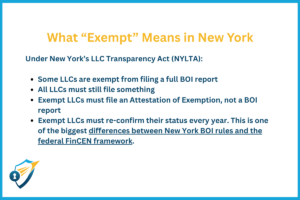
For most small businesses and real estate LLCs, BOI reporting is required.
What Exempt LLCs Must Still File
This is the critical New York difference.
Even if your LLC is exempt, you must file:
An Attestation of Exemption
This filing must include:
The specific exemption claimed
Facts supporting the exemption
A certification signed under penalty of perjury
Annual Confirmation
Every exempt LLC must also file an annual statement confirming the exemption still applies.
Federal rules do not require this. New York does.
Filing Deadlines for Exempt LLCs
LLCs existing before January 1, 2026: file by January 1, 2027
LLCs formed or registered after January 1, 2026: file within 30 days
Missing deadlines triggers the same penalties as non-exempt entities.
Penalties for Not Filing
Failure to file an exemption attestation can result in:
Public “past due” status after 30 days
“Delinquent” status after two years
Fines up to $500 per day
Possible suspension or dissolution by the Attorney General
Exempt status does not reduce enforcement risk.
Bottom Line: Am I Exempt From NY BOI Reporting?
Here is the simplest way to think about it:
If your entity is an LLC in New York, you must file
Exempt LLCs file an attestation, not a BOI report
Non-exempt LLCs file a full BOI report
Everyone files annually
If you manage or form LLCs at scale, exemption analysis is going to be a recurring compliance workflow.
IMPORTANT UPDATE: Please refer to our most recent post for the newest information on the New York LLC Transparency Act HERE.
If you operate or manage LLCs in New York, one of the most confusing compliance questions right now is this: What is the difference between NY BOI reporting and the federal CTA (Corporate Transparency Act)?
The short answer is that they are no longer aligned.
While the federal CTA has narrowed dramatically, New York has moved in the opposite direction by creating an independent, state-level reporting regime that applies to LLCs, regardless of federal status.
Below is a clear breakdown of how the two systems differ, why federal exemptions do not protect New York LLCs, and what that means in practice.
Scope and Applicability
Federal Corporate Transparency Act (Current Status)
When the CTA was enacted, it applied broadly to domestic corporations, LLCs, and similar entities. That changed in March 2025.
Under FinCEN’s interim final rule:
Domestic U.S. entities are exempt
Only foreign entities registered to do business in the U.S. must report
Federal BOI reporting is effectively paused for most U.S. companies
This is a major contraction of federal scope.
New York LLC Transparency Act
New York did not follow this narrowing.
Under NYLTA:
Applies only to LLCs
Covers:
New York–formed LLCs
Foreign LLCs authorized to do business in New York
Does not apply to corporations or LPs
Becomes effective January 1, 2026
Even if an LLC is fully exempt under the federal CTA, it may still be fully reportable in New York.
Core Difference: Federal Retreat vs. State Expansion
The most important distinction is structural.
The federal system pulled back
New York doubled down
As a result, New York LLCs cannot rely on federal exemption status to avoid state compliance.
Beneficial Owner Definitions
On this point, the two laws are aligned.
Both define a beneficial owner as an individual who:
Owns or controls 25% or more of ownership interests, or
Exercises substantial control over the entity
There is no meaningful difference in how beneficial owners are identified. The divergence begins after identification.
Reporting Requirements and Data Collection
What Both Require
Both regimes collect:
Full legal name
Date of birth
Residential or business address
Government-issued ID number
Where New York Goes Further
New York imposes additional burdens not present in the current federal framework.
Applicant Disclosure
Federal CTA: required only for entities formed on or after January 1, 2024
New York: required for all LLCs, including those formed years ago
FinCEN Identifier
Federal CTA: allows use of a FinCEN ID to avoid re-entering personal data
New York: no equivalent exists
Every filing requires full personal data again.
Document Submission
Federal CTA: requires copies of ID documents
New York: does not require document uploads but requires more frequent filings
Exemptions: Same Categories, Very Different Behavior
Both laws recognize the same 23 exemption categories, including:
Banks
Public companies
Large operating companies
Certain nonprofits
Regulated financial entities
The difference is what happens next.
Federal CTA Exemptions
Under the CTA:
If you are exempt, you do nothing
No filing
No confirmation
No renewal
Exemptions are self-executing.
New York Exemptions
Under NYLTA:
Exempt LLCs must file
They must submit an Attestation of Exemption
The attestation must:
Identify the exemption
Provide supporting facts
Be signed under penalty of perjury
New York converts exemption into an active compliance obligation.
Annual Filing Requirement
This is another major divergence.
Federal CTA: event-based updates only
New York: mandatory annual confirmation
Every LLC must file annually:
Reporting LLCs confirm or update BOI
Exempt LLCs confirm exemption status
There is no equivalent annual requirement under federal law.
Filing Deadlines
Federal CTA (Current)
Domestic entities: no filing required
Foreign entities: 30 days from U.S. registration
Updates: within 30 days of changes
New York LLC Transparency Act
Existing LLCs: file by January 1, 2027
New LLCs (post-2026): file within 30 days
All LLCs: annual filing required
New York’s calendar-style compliance is broader and more predictable, but also more burdensome.
Confidentiality and Public Access
Both systems now protect BOI data from public disclosure.
Federal: non-public FinCEN database
New York: non-public NYDOS database
However, New York publicly displays compliance status.
LLCs that miss deadlines may be marked:
“Past Due”
“Delinquent”
This visibility can affect banking, contracts, and transactions.
Penalties and Enforcement
Federal CTA
Civil penalties: up to $500 per day
Criminal penalties for willful violations
Enforced by FinCEN and DOJ
New York
“Past due” status after 30 days
“Delinquent” after two years
$250 initial penalty
Up to $500 per day ongoing
Possible suspension or dissolution by Attorney General
New York penalties are civil and administrative, but the operational risk is significant.
Legislative Uncertainty Still Matters
As of December 2025, New York lawmakers have acted to preserve state-level reporting regardless of federal changes. Pending legislation would confirm that NYLTA applies to both domestic and foreign LLCs.
The intent is clear: New York does not plan to follow federal retrenchment.
Practical Compliance Reality
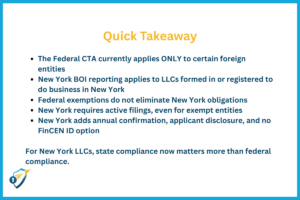
For New York LLCs:
Federal exemption does not remove state obligations
Exempt entities still file annually
Applicant data must be tracked long-term
No FinCEN ID shortcut exists
For foreign LLCs in New York:
Dual compliance may apply
Separate systems and timelines must be managed
The Bottom Line
The difference between NY BOI reporting and the federal CTA is not technical. It is structural.
Where the federal BOI is currently narrow and limited, the New York BOI is broad, active, and recurring. Exemptions reduce data disclosure, not filing obligations, and annual compliance is unavoidable for New York LLCs.
If you manage LLCs connected to New York, state compliance now carries more weight than federal compliance, and planning around that reality is no longer optional.