
Table of Contents:
- Important Legislative Context (December 2025)
- Who Is Covered by NY BOI Rules?
- The 23 Exemptions New York Recognizes
- Financial Institutions and SEC-Regulated Entities
- Investment and Fund-Related Exemptions
- Insurance and Other Regulated Businesses
- Tax-Exempt and Nonprofit Organizations
- Operating Company Exemptions (Most Common, Most Misunderstood)
- What Most LLCs Get Wrong About Exemptions
- What Exempt LLCs Must Still File
- Filing Deadlines for Exempt LLCs
- Penalties for Not Filing
- Bottom Line: Am I Exempt From NY BOI Reporting?
IMPORTANT UPDATE: Please refer to our most recent post for the newest information on the New York LLC Transparency Act HERE.
If you operate an LLC in New York, one of the most common questions right now is simple but critical: Am I exempt from NY BOI reporting?
The answer is often misunderstood.
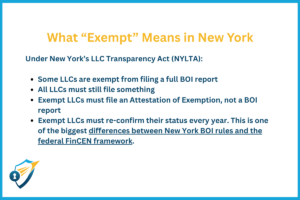
Even if your LLC qualifies for an exemption, you are still required to file with New York.
There is no “do nothing” option under New York’s Beneficial Ownership rules.
Below is a clear, practical breakdown of who is exempt, what exemption actually means in New York, and what exempt LLCs are still required to file.
Important Legislative Context (December 2025)
As of mid-December 2025, there is pending legislation that could affect the final scope of NY BOI reporting. Governor Hochul has until December 19, 2025 to act on Senate Bill S8432, which would clarify that NYLTA applies broadly to both domestic and foreign LLCs.
This article assumes the bill is signed and the full exemption framework applies. LLCs should continue monitoring New York Department of State guidance for updates.

Who Is Covered by NY BOI Rules?
Before asking whether you are exempt, you need to confirm whether your entity is in scope.
You are covered by NY BOI rules if your entity is:
A New York LLC (formed by filing Articles of Organization with NYDOS), or
A foreign LLC (formed elsewhere but registered to do business in New York)
If your entity is an LLC and touches New York, you must file either:
A BOI report, or
An attestation of exemption
The 23 Exemptions New York Recognizes
New York adopted the same 23 exemption categories used in the federal Corporate Transparency Act. However, New York applies them differently.
Below is a structured overview of those exemptions.
Financial Institutions and SEC-Regulated Entities
These entities are generally exempt because they are already subject to extensive federal or state oversight.
Common exemptions include:
Public companies reporting under the Securities Exchange Act
Federal, state, local, or tribal government entities
Banks and bank holding companies
Credit unions
SEC-registered broker-dealers
Securities exchanges and clearing agencies
Registered money services businesses
These exemptions typically apply to large, heavily regulated organizations, not small operating LLCs.
Investment and Fund-Related Exemptions
Certain investment structures qualify for exemptions, including:
SEC-registered investment companies
SEC-registered investment advisers
Venture capital fund advisers that file Form ADV
Certain pooled investment vehicles advised by regulated entities
Important limitation: subsidiaries of pooled investment vehicles are not exempt unless they meet separate criteria.
Insurance and Other Regulated Businesses
New York recognizes exemptions for:
Insurance companies
State-licensed insurance producers with a physical U.S. office
Public accounting firms registered under Sarbanes-Oxley
Regulated public utilities
Certain financial market utilities
Again, these exemptions generally apply to regulated operating entities, not holding companies.
Tax-Exempt and Nonprofit Organizations
Entities that qualify under the Internal Revenue Code may be exempt, including:
501(c) tax-exempt organizations
Certain political organizations
Charitable trusts under Section 4947
Important clarification:
Losing 501(c) status triggers a 180-day grace period
“Nonprofit” in name alone does not qualify. IRS status controls.
Entities that exist solely to support tax-exempt organizations may also qualify, but the ownership and funding requirements are strict.
Operating Company Exemptions (Most Common, Most Misunderstood)
Large Operating Company Exemption
This exemption applies only if all three conditions are met:
More than 20 full-time U.S. employees
More than $5 million in U.S. gross receipts on the prior tax return
A physical operating office in the United States
Most small businesses and holding LLCs do not qualify.
Subsidiary of an Exempt Entity
An LLC may be exempt if it is:
100% owned or 100% controlled by certain exempt entities
Partial ownership does not qualify. FinCEN and New York interpret “controlled” strictly.
Inactive Entity Exemption
This exemption is extremely narrow. To qualify, an LLC must meet all six criteria:
Existed before January 1, 2020
No active business operations
No foreign ownership
No ownership changes in the last 12 months
Less than $1,000 in financial activity
No assets anywhere
Very few entities qualify.
What Most LLCs Get Wrong About Exemptions
Common misconceptions include:
Being unprofitable does not create an exemption
Single-member LLCs are not exempt
Real estate holding LLCs are not exempt
Passive income does not qualify as inactivity
HOAs not classified under 501(c) are not exempt
For most small businesses and real estate LLCs, BOI reporting is required.
What Exempt LLCs Must Still File
This is the critical New York difference.
Even if your LLC is exempt, you must file:
An Attestation of Exemption
This filing must include:
The specific exemption claimed
Facts supporting the exemption
A certification signed under penalty of perjury
Annual Confirmation
Every exempt LLC must also file an annual statement confirming the exemption still applies.
Federal rules do not require this. New York does.
Filing Deadlines for Exempt LLCs
LLCs existing before January 1, 2026: file by January 1, 2027
LLCs formed or registered after January 1, 2026: file within 30 days
Missing deadlines triggers the same penalties as non-exempt entities.
Penalties for Not Filing
Failure to file an exemption attestation can result in:
Public “past due” status after 30 days
“Delinquent” status after two years
Fines up to $500 per day
Possible suspension or dissolution by the Attorney General
Exempt status does not reduce enforcement risk.
Bottom Line: Am I Exempt From NY BOI Reporting?
Here is the simplest way to think about it:
If your entity is an LLC in New York, you must file
Exempt LLCs file an attestation, not a BOI report
Non-exempt LLCs file a full BOI report
Everyone files annually
If you manage or form LLCs at scale, exemption analysis is going to be a recurring compliance workflow.